
Background information
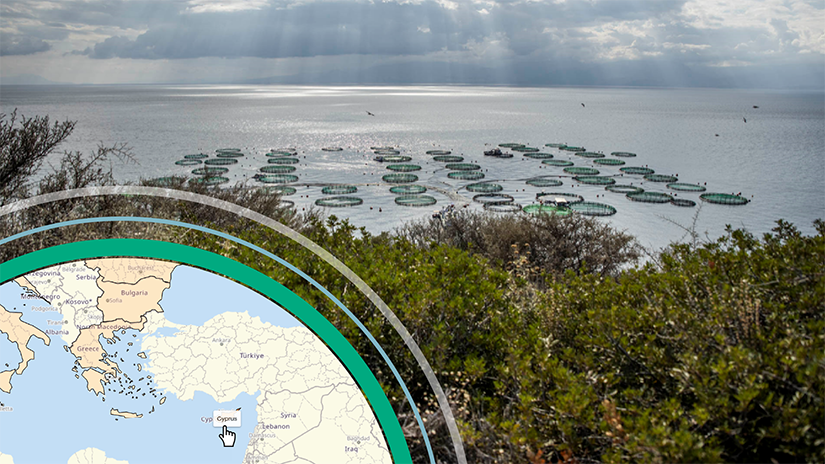
Type of species farmed
Gilthead seabream (Sparus aurata), European seabass (Dicentrarchus labrax), meagre (Argyrosomus regius), rabbit fish (Siganus rivulatus), pandora (Pagellus erythrinus), red bream (Pagrus pagrus), Japannese bream (Pagrus major), rainbow trout (Oncorhynchus mykiss), sturgeon (Acipenser baeri) and marine shrimp (P. indicus & P. vannamei).
Source: 2023, Department of Fisheries and Marine Research, DFMR
Type of production method
In Cyprus, in 2022, production occurred almost entirely in marine waters, mainly using cages and, in marginal percentage, in ponds. Negligible amounts of farmed production occurred in freshwater, in tanks and raceways.
Source: 2025, EUMOFA
Sector’s size (production and consumption)
Source: 2024, EUMOFA; 2023 DFMR
Trends (past and future)
- Government policy in the aquaculture sector aims at the sustainable and environmentally balanced development of aquaculture to maximise its contribution to domestic fish production, in line with the needs of the local and international markets and by providing high quality and hygiene products that meet the consumers expectations.
- Continue to promote, support and monitor the further development of the sector with emphasis in offshore aquaculture. This practice ensures smaller environmental impact and ensures the good state of the marine environment.
Source: MNSPA; 2021, DFMR
Impact of aquaculture in the country’s economy, food market and labour market
- Aquaculture in Cyprus constitutes around 85 % of the total Cypriot fisheries production in both quantity and value, providing around 350 full-time direct jobs and contributing to the creation of hundreds of others in other ancillary professions. Aquaculture is an integral and very important part of the Cypriot fisheries sector and, more generally, of the national wider rural economy. This activity has been the fastest growing primary food production industry in Cyprus over the past 15 years.
- Aquaculture products are the third most important product in value of exports from the wider Cypriot primary production sector after potatoes and citrus fruits and thereby contributing significantly to the reduction of Cyprus’ negative trade balance in relation to fishery products. Marine aquaculture accounts for more than 99 % of the total national aquaculture production and also has the greatest potential for growth. In contrast, freshwater aquaculture is restricted by the reduced availability of fresh water and the high operating costs associated with the implementation of water recirculation systems.
- In addition, Cyprus is among the top 5 EU countries in terms of the contribution of aquaculture to fisheries production.
Source: MNSPA; 2021 DFMR
Challenges and opportunities
- The recovery from the Covid-19 pandemic, adaptation to a changing global environment and the green transition.
- To contribute to food security in the Union through competitive and sustainable aquaculture and corresponding markets.
- The development of a sustainable blue economy and the promotion of prosperous coastal communities.
- EU funding opportunities
- Reduced production of capture fishing.
- Applicability and use of new technology with more efficient aquaculture systems.
- Differentiation of products.
- The transition to sustainable food systems as well as expectations citizens are evolving and bringing significant changes to the food market.
Source: MNSPA
Employment and number of enterprises
3 on-shore Marine Hatcheries, 1 Shrimp Grow out / Hatchery Unit, 9 Marine off-shore Units, 8 on-shore freshwater aquaculture units.
350 employees
Source: MNSPA
Multi-annual National Strategic Plans for the development of sustainable Aquaculture
Relevant Authorities
Applicable Legislation
- Aquaculture Law 2000 until 2010
- Aquaculture (General) Regulations 2002 until 2010
- Water pollution control (Water quality for shellfish) Ordinance of 2001 (P.I. No. 9/2001)
- Water pollution control (Freshwater quality standards to preserve the life of fish) Ordinance of 2001 (P.I. No. 10/2001)
- Animal Health Law, 2001 (Law No. 109(I)/2001)
Applicable Procedures
Aquaculture activity is also regulated by relevant provisions in other legislation, such as the Environmental Authority, concerning the safeguarding of the state and quality of the environment, as well as the Veterinary Services and Animal Protection and Welfare Services on public health issues and the health and well-being of farmed organisms.
- The License to Establish and Operate a Fish Farm is issued based on the Aquaculture Laws 2000 to 2010 and their respective amendments as well as the relevant regulations.
- Planning Permit from the Department of Town Planning and Housing.
- Department of Environment - Discharge Permit.
- License to establish and operate a fish farm by DFMR.
- Veterinary License for the Production of Aquaculture Products by the Veterinary Services.
- License to Establish and Operate a Fish Farm is issued based on the Aquaculture Laws 2000 to 2010 and their respective amendments as well as the relevant regulations.
- Environmental Approval by the Department of the Environment.
- Permit for the use of marine space from the Council of Ministers (the proposal is prepared and submitted to the Council by the Minister of Agriculture, Rural Development and the Environment).
- License for the Establishment and Operation of a Fish Farm by DFMR.
- Veterinary License for the Production of Aquaculture Products by the Veterinary Services.
National associations and networks
Cyprus Mariculture Association
Contact Details
Department of fisheries and Marine Research, Cyprus
Constantinos Moustakas, Fisheries and Marine Research Officer
- Telephone number: +357 2280 7850